Tag Archives: review

Review: Maps of the Imagination

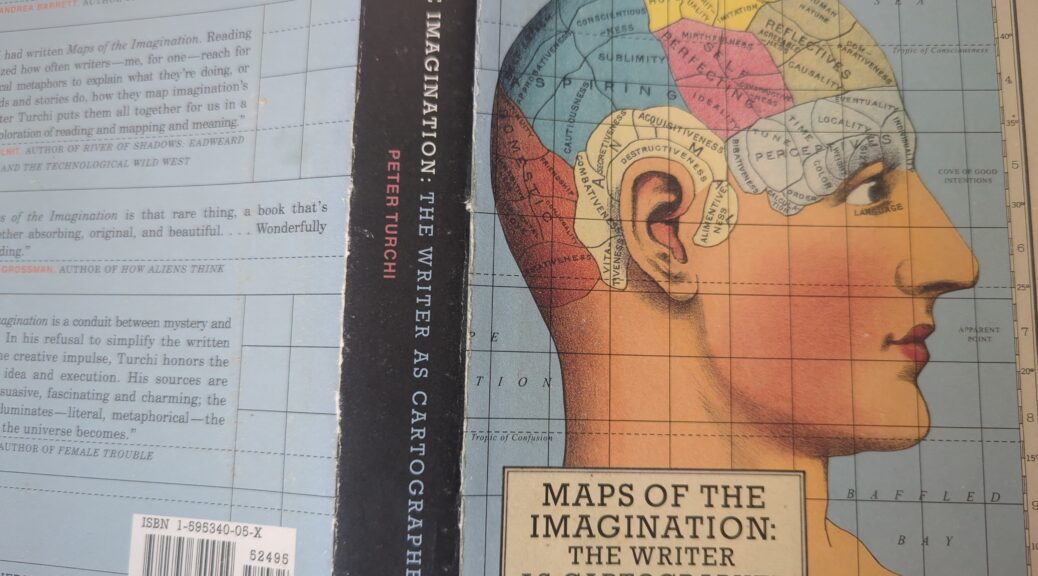
Someday (soon I hope) I will be sharing more of my stellar cartography efforts for all to appreciate and to use in their mission/ campaigns or to be inspired by when writing or talking about Star Trek, but on the way between now and then, I sometimes read material tangential to all of these efforts. Last year was marked in my life by a considerable amount of time spent in waiting rooms. Aside from taking more naps while sitting upright (a learned skill) I tend to read more books in these situations, and one of the books that helped me pass the time last year was Maps of the Imagination: The Writer as Cartographer, by Peter Turchi.

I think for anyone who has been in the writing craft for a while, it’s likely to have encountered the concept of ‘the mind palace’ which is a storytelling memory device of walking through your narrative as if going through a home or a castle and traveling from room to room. Memory seems to map experience with place, and so the writer can take advantage of this. I have heard many orators explain this as their practice of how to deliver a talk with minimal, if any notes, and in pre-literate society without the technology of alphabets, papyrus, or electromagnetically-recorded binary-encoded type, the mind palace or similar imaginary “maps of the mind” must have been an essential tool for educated minds to transmit epic stories, deliver hard-won wisdom, and preserve generational knowledge.

Turchi moves a little further afield and suggests that far beyond writing, almost everything we engage in is a matter of trying to create or use a denotation system in order to make massively overwhelming reality into navigable, comprehensible, and communicable portions which we can take with us via either memory or by any of an innumerable methods of demarcation (maps!), and which we can ultimately share with or pass on to others. What is an alphabet if not a mapping of sounds? Are words and phrases not a legend for meaning? We use all of this to compress the universe into digestible bits and then to expand them again when we look to go back out into the terrain to explore more of the world. Animals often have their own methods of this too. A bee may dance to tell tell other bees where she has found pollen, and they memorize and exchange this compressed information, trading the complexity of the world for a few signals that can lead them to success and security for the hive. Although there is no written or recorded persistence of the insect’s game crossover between “charades” and “telephone”, the little bee has made herself and her sisters a map.

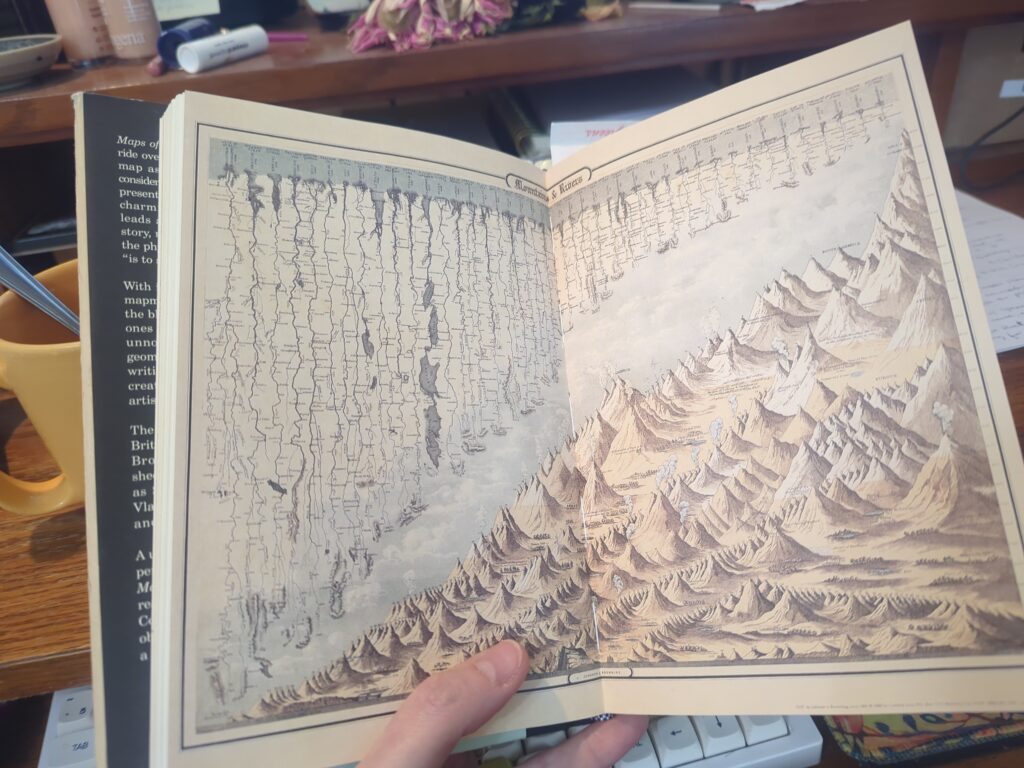
A clever map comparing lengths of rivers and elevations of mountains around the world
An example of one of the diverse selections of maps in the book’s figures: the comparative lengths of rivers and the elevations of mountains are arranged on a single spread!

When you read Turchi’s book, you may get the feeling that everything we do and all the media we engage with is maps. We might even argue that reality therefore is a map as well, just the highest and most detailed form (you can see where simulation theorists might be caught up in thoughts of this nature! But Turchi doesn’t spend much time worrying about this). In Turchi’s opening page he proposes that: To ask for a map is to say “Tell me a story.” And the book is filled with a diversity of ideas expanding on what kinds of things are maps and what it means to be a cartographer and how we choose what to focus on in our mapping systems and ultimately, what use the approach of mapping means for us as writers; ultimately what is writing if not an exploration on which we are trying to bring along another person?

So we as writers might say: here is the story, and how it unfolds, and if you follow along on the path I’ve marked out, you will share an experience in the thought palace, and if I’m especially perceptive and well honed as a writer, I will have mapped out something about the shared human experience that will be unpacked in your own journey as you follow the trail I’ve drawn, such that you and I will have seen the same landscape but from our own eyes, in our own unique perspective. And maybe you too will be inspired to make another map for another traveler.

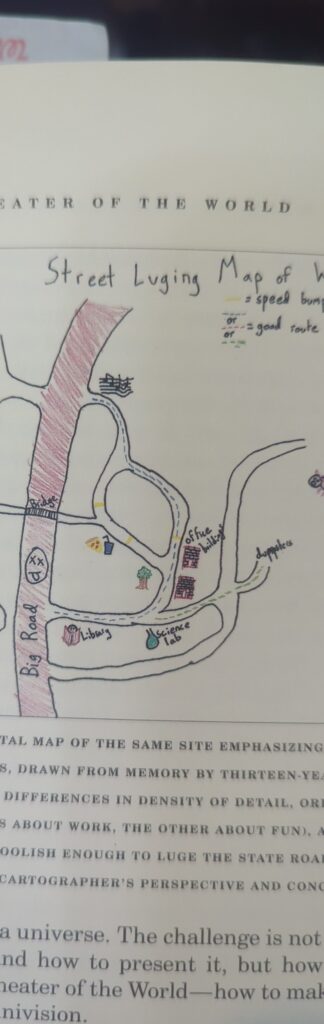
A map drawn by the author's young son
The author includes a map made by his young son focused on the best winter sledding routes on their local college campus.

The range of explorations in the book is too wild to summarize, both serious and whimsical, popular and esoteric, and yet all pulled together in a way that feels like an enlightened “aha!” The imagination will not be made up of straight lines, of this it is clear, but the journey along with this author through rabbit trails of history and fiction, of sledding with his son and reading the plot of his father’s land, of tracing cows daily plodding through pasture, of the cartography of common board games and the logic of Sunday morning cartoons, of non-linear stories and of treasure maps, of higher geometries on 2-D planes – it all is a guided map tour charting a course through the ways we navigate our interior and exterior lives using story as our cartographic stars by which we are guided, and along which we may point others. ~

Review: Midshipman Hornblower

I know it’s not a Trek book exactly, but hear me out, it’s related.

So, some years and years ago, I had come across a behind the scenes interview with the actors talking about their experience starting out on the set of Star Trek: The Next Generation. I remember Patrick Stewart saying that when he asked for direction on the character of Jean Luc Picard, Gene tossed him a copy of Horatio Hornblower and said that’s Picard, do that.

All I could infer was that is was some age-of-sail historical fiction (alluded to in the show occasionally in holodeck programs). I had spied the books on the library shelf once or twice, but the timing never lined up for me— I always had too many things I happened to be reading anyway.

But this past winter, it was time. I happened on the first two Horatio Hornblower books at a library sale for just a buck and I threw them on top of my tipsy tower of selections, dropping a twenty like the big spender I am. I can’t help it. Books look at me like lost kittens and I can’t just let them there at the book pound, forlorn and unappreciated. So these came home with me. Even if I only have the time to hug them and sniff their sweet VOCs and not actually read them all. It’s my therapy. My book-o-phile peeps all get me.

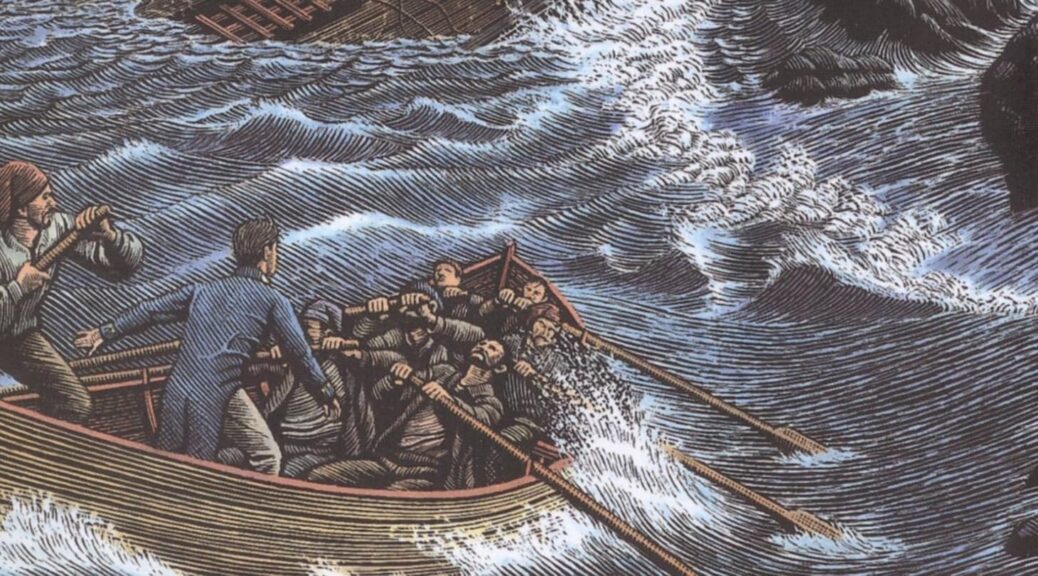
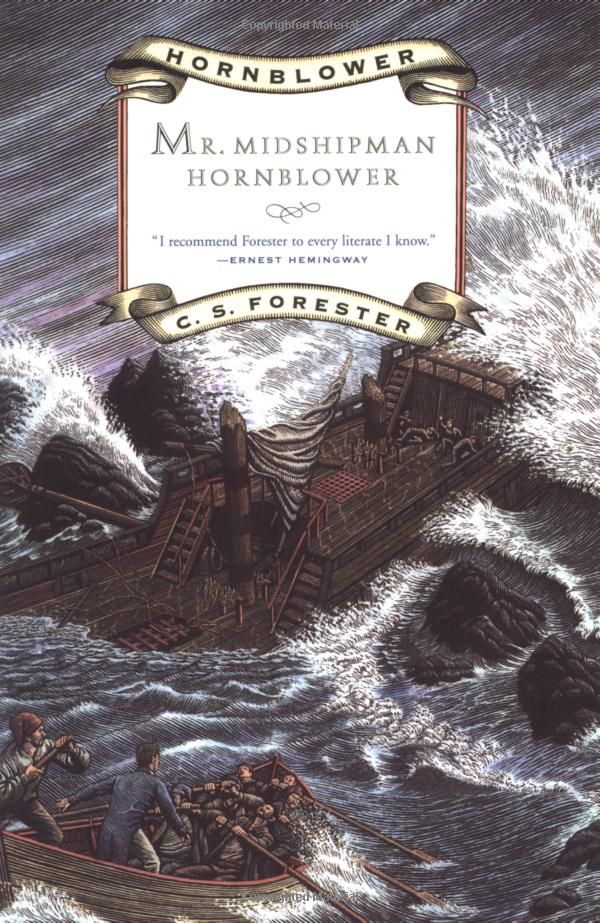
What especially sold me on Hornblower this time though was that, as opposed to the fading hardcover library copies, in the 1998 softcover edition of this book, on the front cover directly under the title it features one reviewer quote that makes it feel like a crime to pass this book up. It reads thusly:

“I recommend Forester to every literate I know.” —Ernest Hemingway

Ernest gosh-darn Hemingway! I’ve never actually read a significant amount of Hemingway, but I understand he comes highly recommended. And if he recommends Forester to every literate (and hey, I can read!) well, by-golly-george, put this in my reusable store bag. Let’s go.

My expectations were high, is all I’m getting at here. What I expected going in was basically Jean Luc Picard on the high seas in a page turner literary masterpiece.

Friends. I was not disappointed.

Mr. Midshipman Hornblower
By C.S. Forester

As you crack open this book, a scrawny adolescent is delivered, wet and bedraggled, to his first ship assignment. When asked his name he gives it as Horatio Hornblower. “What an infernal piece of bad luck for you.” One of his new crew mates dishes out. On further hearing that he’s seventeen, the opinion is that he’s begun his sailing career too late in life to know anything of value and he should have begun at twelve. Picard, I mean Hornblower, responds with a promise to read up on the parts of the ship in his Seaman’s handbook.

We’re only a few pages into this leading chapter when our hero is set about with a serious quandary— while pasty colored, gawky, and inexperienced, he’s very book smart and quickly outpaces men twice his age in his navigational studies. This gets under the skin of one older Midshipman who proceeds to make things miserable enough for Hornblower that the poor boy contemplates how he’d much rather find a way of quitting this life and thus have an end to the never ending torments.

One day at a game of cards our young protagonist seizes an opportunity to accuse his tormentor of offending his honor, and there’s nothing for it. He demands the right to duel to the death in defense of his reputation and good name of Picard, I mean Hornblower.

There’s no chance of him surviving this match. But he’s headstrong and determined and the duel is set.

I won’t tell you how it’s resolved. Suffice it to say this is the first chapter in an eleven book series all titled for Hornblower and following him into his Admiralty, so I don’t think I’m ruining the plot for you by saying he survives, but the manner in which he does so is eminently worth reading.

The following chapter entitled Hornblower and the Cargo of Rice, in which he guides a prize ship with a cargo hold full of valuable rice, is even more thrilling and I am still, weeks later, smiling at the memory of having read it. Each chapter, while tracking chronologically in a timeline of Hornblower’s career, can serve as a standalone read unto itself, clearly serving the love of those of us who find episodic fiction most endearing.

They’re all amazing, detailed, and whip-smart, full of twisting plots, sharp character studies, well informed context of sailing ships and battle tactics on sea and on land, and convincingly set scenes throughout the Mediterranean and Western European coast. Every single chapter deserves an entire review unto itself.

If you need a real Picard series, Hornblower is your man.

Picard

Review: Perchance to Dream (TNG novel)

I had a wonderful experience on vacation this summer, exploring a used bookstore in another state several hours away from home. This place had a whole scifi section and a book case that included several solid shelves full of Star Trek novels.

Years ago, in the halcyon days of the 90s, when we didn’t know we were living the dream, I used to buy TNG paperbacks at the pharmacy around the corner from me at full price with my babysitting money. I considered this a fair trade of goods and services, and I really enjoyed the books.

But as life carried on and I had to handle my limited storage space in apartments and my first time home, I had to let go of those paperbacks. And now I’m making up for it by restocking, and discovering titles that I never saw on the pharmacy’s spinning rack in the 90’s. Who knew the future would return to me such bounty?

So the first I grabbed out of this newly acquired stack happens to be Perchance to Dream, by Howard Weinstein. And I am promising you my unfiltered hot takes. Spoiler alerts abound: I’m not going to any effort to hide the events of the story.

Lets get into it.

Perchance to Dream (2000)
by Howard Weinstein

I’m not really sure how to begin talking about this novel. I’ve tried to put my finger on just why it’s difficult to select an approach, and I think it’s because this novel isn’t especially remarkable. It’s easy to talk about something very bad or very good, very bold or very uncanny. But with a book like this, I feel that the author has some writing chops, and the story is followable, but nothing is especially unique or clever.

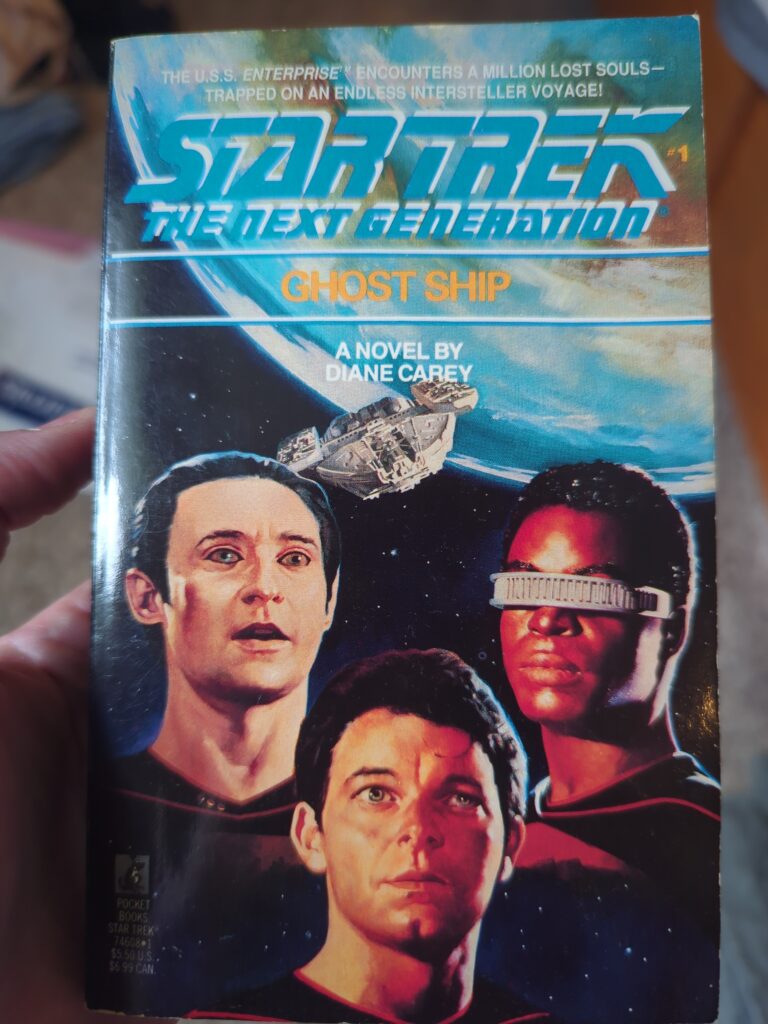
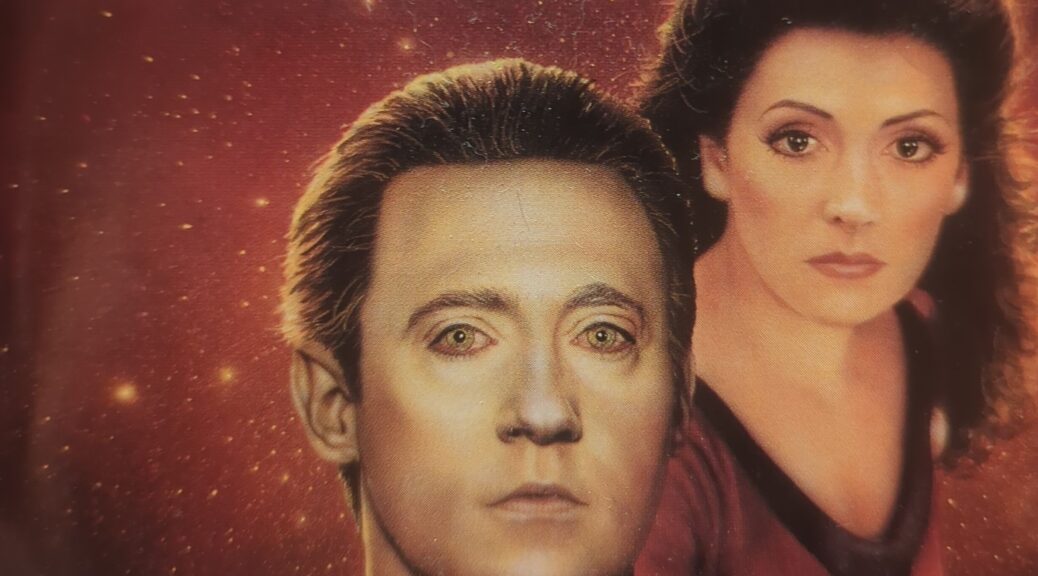
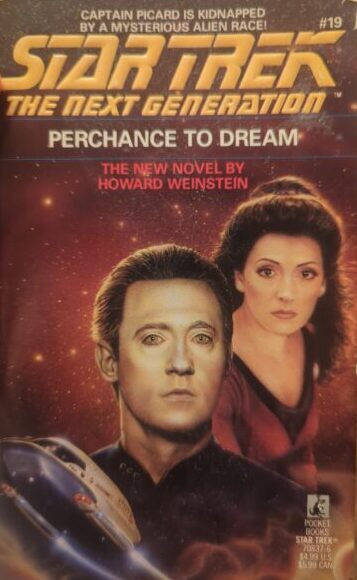
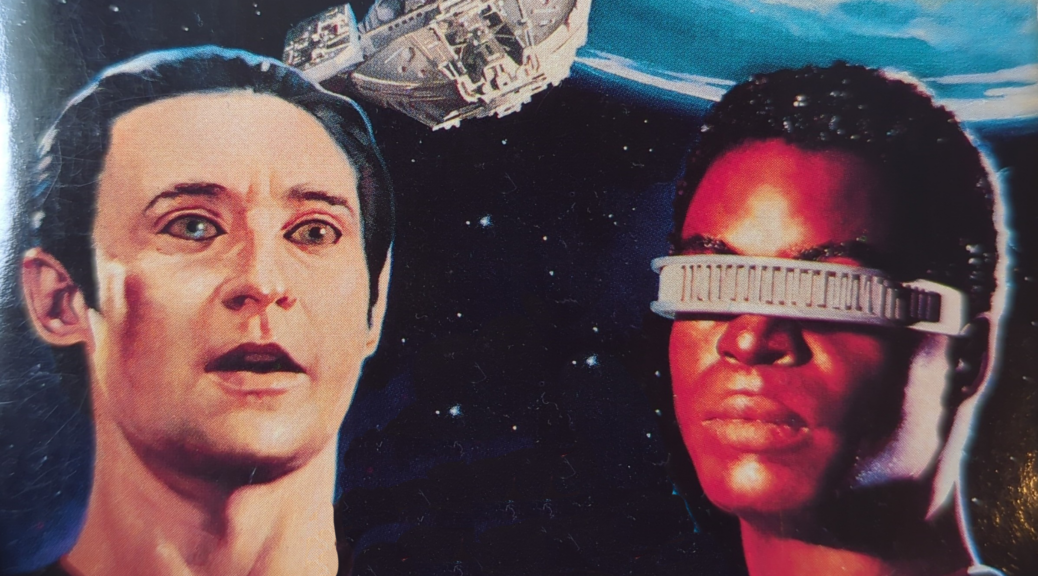
While the book cover advertises Data and Troi and is framed in the beginning with their plight, and in the end with their discovery— the story’s A plot seems to consist mainly of Picard. It’s Picard’s problem that the away team has gone missing before his eyes on the view screen. One moment it was in the grip of an unknown alien vessel with a belligerent captain, the next moment, it is stolen away within a flash of rainbow energy.

The shuttle crew was on a survey mission, studying the geography of the planet. Aboard are some Starfleet hopefuls including Wesley and two other sixteen year old companions. Data and Troi are there to guide them through the easy geology survey as a prelude to their further training. The kids act like kids.

Beverly Crusher is teased in a few scenes at the beginning of the book, but as the plot thickens, she basically disappears to distract herself in the medical lab, worried about her missing son, but being helpless to do anything about it. Of all the deciscions made in the framing of this story, this one probably discouraged me the most. Crusher essentially decides that Troi is with him whereever he has gone missing to, and that as her closest friend she trusts Troi to look after Wesley. This isn’t entirely awful. As a parent I know from experience that sometimes, especially with your proto-adult teenagers, you have to trust other reliable adults to guide them in life. But Dr. Crusher is a smart woman, and as the story continues, there is ample opportunity to graft her into the search for her son. I can’t imagine not lending all the effort in my power to offer— even if the solution didn’t result from any of my own striving. Dr. Crusher doesn’t strike me as an indifferent or emotionally distant character, so this was difficult for me to accept in the story. Whether you like or dislike the mother and son Crusher duo, this is simply too reductive.

While each standing on their own bridge, tensions flaring over the disappearance of the shuttle, Picard and the alien captain are inexplicably swept away by the same rainbow juju as took the shuttle. Then, in a budget version of the TNG TV episode “Darmok”, the story follows both captains on the planet’s surface where they suddenly find themselves, cut off from contact with their respective ships. Picard tries to reach out to the other captain but she is aloof and elusive. When Picard has some success at spearing and cooking up some fish, his counterpart comes out of the shadows long enough to eat with him. Then, in the night, the ground shifts and almost swallows him, but, in a trust building turn of events, the alien captain makes the difference and saves our captain. (That was close. We almost saw the end of Picard right there. Cue final credits roll.)

Meanwhile the shuttle crew discovers their entire shuttle has been transferred to a cavern. Which is really scary because one of the kids hates caves (it’s been established in the earliest scenes). Troi does comforting counselor things. Data is characteristically unperturbed. Wesley doesn’t seem so annoying because the other two kids with him take the stage with an awkward non-romance…Remind me again, why does it matter to the story that Wesley happens to even be in this episode? He just seems like a poorly given stakes item, hanging in the balance. But other than a one off narrative nod, the connection to the fact that Picard lost Wesley’s father Jack under a previous mission, never really adds any pressure to the issue for Picard.

Tangentially, the Enterprise is being diverted to the matter of the shuttle, away from the ship’s mission to save some miners in need of emergency care. But that doesn’t add to the stakes either. No one is poorly affected by the diversion of the Enterprise for days over the curious world with the Rainbow strobe effects. We’re not in any rush. Why the author didn’t use this to up the stakes especially for Picard in his leadership decisions, is beyond me. If we wanted to just do something to get Beverly out of the picture, she could show more torment over her son going missing, but Picard could ask her to trust him and need to rely on her to take another shuttle ahead to the mining colony to begin their emergency treatment. See? This isn’t hard to lend stakes and credibility with everything that is already in the pages of this book.

Somewhere in the middle of the book, we are given some new insight which our intrepid heroes cannot have. The rainbow light shows are the work of sentient beings, and the glowing creatures are curious about these odd things in their creative space which arrived in weird containers in the sky. The story becomes about a planet of powerful earth shapers, and a remnant alien ship desperate to make a home, while our Prime Directive driven crew cannot allow the settlement project to proceed without proper regulatory zoning law having been met to be sure this isn’t already someone else’s planet— and besides, a shuttle is unaccounted for, and that can’t be waved off.

In the end, the light creatures manage to puppet Data and use him to communicate. Which is not a disturbing violation of personhood at all… and everything is hashed out between them and the newcomers, because it turns out they are lonely just shaping the geology of their world with no one to appreciate their effort. Besides, they sleep for a thousand years between every earthwork at which time their leader is whichever ball of light reawakens first and there’s no chance that won’t work… like with that one dissenting ball of light who thought that the current leader was making a serious mistake checking if these weirdos were legit lifeforms.

It’ll be cool.

Now that everyone is settling in nicely on the planet that tried to swallow him in an active rockslide, Picard gathers up the shuttle and the Enterprise zips off to help those miners. The end.

I know I’m being a little hard on this book. I did enjoy reading it. In fact, I think if I had read it when it back when it had been published, I may have been more enamored. Things I liked about it were that both of the aliens introduced in this book were very alien; the ship of refugees had a description that would have stretched old TNG makeup departments and the other aliens were genuinely made up of light and had a unique society. Data and Troi were juxtaposed well with one another as mentor characters to the teens, and if I had been reading this book as a teen I may have felt a connection to these characters (Gina, Ken, and Wesley) as they were strongly featured. Like wise, the plot would not have challenged me, allowing me to keep up with the story. Even the multiple times that Geordi spouts off clichés might have failed to have me grinding my teeth as I did now reading this book in my adulthood.

In the end Picard sums up the question the book’s author wants us to ask: Do sentient beings create only for the sake of creating, or do they create for an audience who gives a purpose to their creative act?

And this is why we are all here for anything Star Trek. To ask the unanswerable questions. Am I writing this review for myself, or for you, “dear reader”? I’m not sure. I certainly get more out of it by imagining a friendly ear in the world, inclined in my direction.

Some how, as the kids say now, this book was mid. I didn’t not like it. I think I just wish I could reach through a space-time anomaly to beta read this manuscript and leave some suggestions for the author, immediately after which, I would witness the cover art time-shift to an honest-to-the-content depiction of Picard and Wesley, and pickup the book from my nightstand to give it another chance.

DS9 “The Nagus”

Okay, so just last week I was watching DS9’s “The Nagus” episode. I love DS9 but it’s been years since I’ve watched much of it. My family is doing a watch through from the beginning and when I can, I sit down with them to enjoy it. So many wonderful little things stand out to me now.

As a parent, Sisko’s conundrum in guiding and understanding Jake without putting him off strikes so much more to the core now. I’m not even sure I heard this lesson from his perspective when the show was airing and I watched in my parents’ living room. I probably only heard the part where you should trust your kid. Completely missing the part where you have to trust the values you instilled in your kid to take hold and guide him too. It’s a nuance, but it matters. Seeing him realize that overreacting with his own authority will force Jake to choose between his father or his friend is so real to me now. I have entire parenting mantras in my head developed to keep myself from overreacting.

The Ferengi really rule this episode though, as the title implies, and getting Wallace Shawn of The Princess Bride Vizzini fame for this role made it eminently enjoyable and truly elevates the Ferengi as an entire species, epitomizing the cultural character of the race. It’s hilarious and yet demands to be taken seriously for what it is at the same time. Brilliant casting.

As I’ve had my head in the Stellar Cartography effort for a year now, The name dropping of all of the Ferengi worlds perked my ears: Balancar, Volchok, Tarahong, Clarus, Lappa, Thalos…. they’re all dropped in one scene around a conference table as the Grand Negus addresses his loyal trade members.

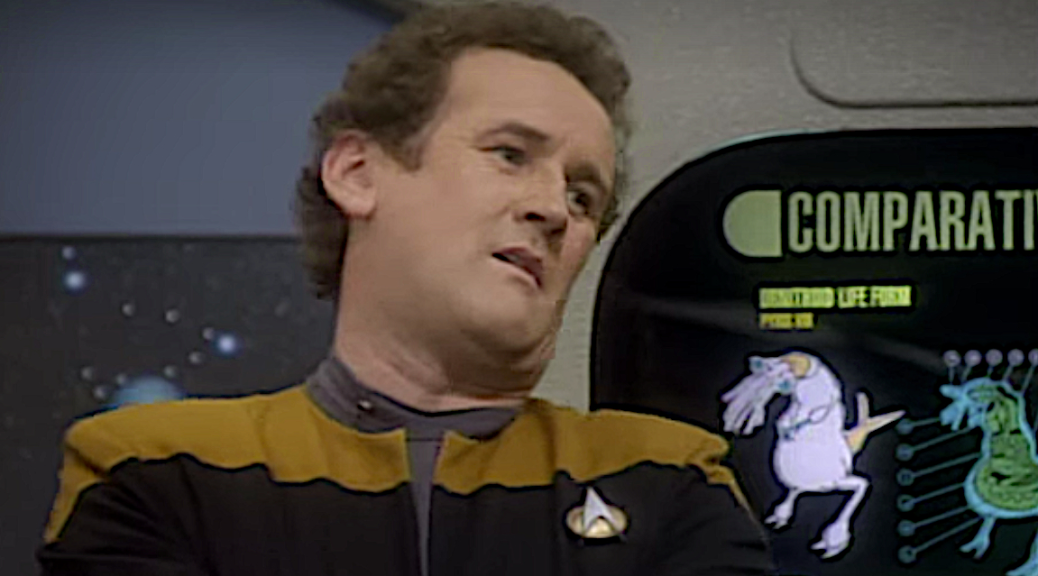
But that’s not all. Oh no. In a supporting subplot, Miles O’Brian is the substitute teacher standing in for his wife Keiko. Over his shoulder on the display board is a wacky alien creature with a noodle mouth and a fish tail and it has an anatomical diagram as well. “What is that?” I asked my husband repeatedly as we watched. I was sure someone online must have a name for it.

But before I even got around to trying to search for it, I was incidentally browsing old trek sites looking for more maps to reference or share and came across a fan site called Collecting Trek (https://collectingtrek.ca/). In it, the collector has an article (https://collectingtrek.ca/2023/02/15/medical-reference/) visiting the Starfleet Medical Reference Manual and how it came into being. It’s a very fun read. And I learned that in the end, DS9’s set creators grabbed the previously non-canon creature reference from the Medical Manual, putting it on screen and thereby canonizing it! It brings a smile to my face.

You may recognize some of the images from other scans taken from it- the tribble anatomy chart in particular has made the rounds.

And now I have another book I’m going to have to get a hold on for my personal collection, because a medical chart is essentially another kind of map, right?