Let’s take it from the top, shall we?
Since rekindling an interest in Star Trek The Next Generation novels and comics, I’ve decided to have a go at the first in the numbered novel series. That brought me to Ghost Ship, by Diane Carey. [minor spoilers ahead…]
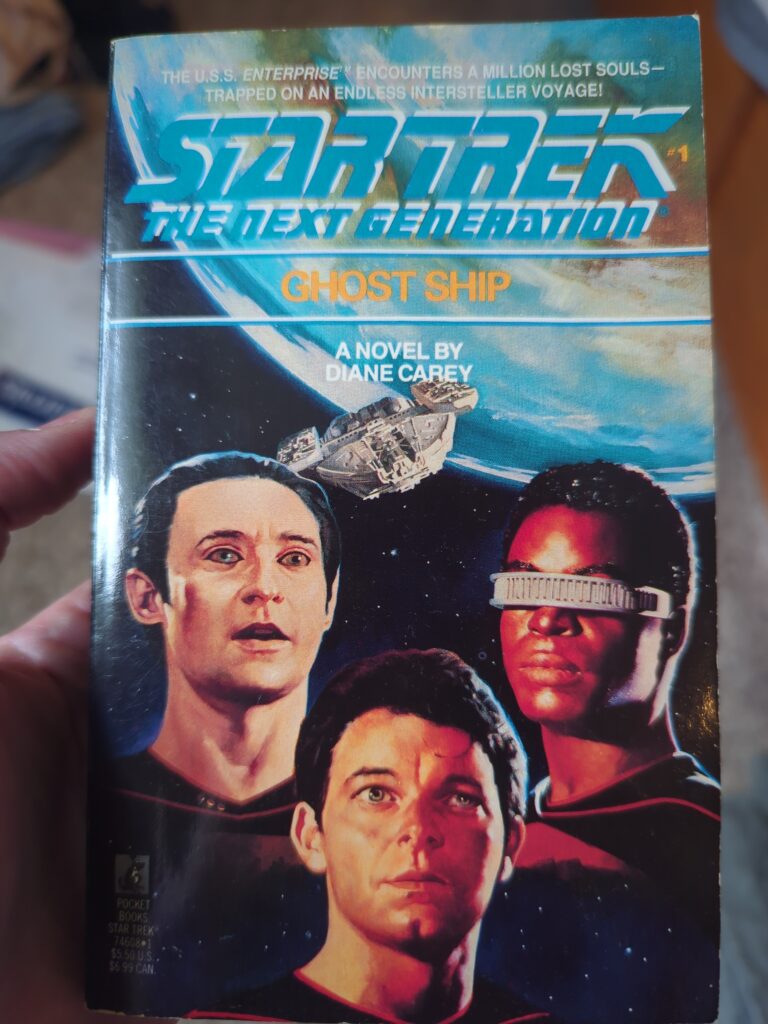
Ghost Ship (1988)
by Diane Carey
As most fiction paperbacks are wont to do, this book tells you what you’re getting into right up front, that is via the back cover. Writing in 1988, the author sets the prologue in 1995, placing us in an as-of-then future historical fiction (heh) when a Russian Aircraft carrier is overtaken by an unexplained force. The prologue is very well written, and I almost wished she’d remained writing a book in the near future of the time in which the author was authoring this. But it does as advertised and promptly jumps us into the 24th century, where Deanna Troi is being plagued by apparitions of those unfortunate missing sailors, their life forces being trapped in an inter-dimensional entity, floating through outer space.
The book explores along a couple of themes. I think the first might be identified as something like “Perception” as it compares things like Troi’s empathy with LaForge’s augmented vision. Picard even undergoes sensory deprivation in the course of the story to try to understand what it might be like to live only as a disembodied consciousness (this is accidentally salient and if done intentionally would have been a great presaging of the future assimilation of Picard).
Another theme being explored is the question of life and its value. The debate held is over the definition of murder versus euthanasia— here we see Riker advocating for the preservation of life and holding out that it’s not the Enterprise’s business to trot about the universe deciding who is suffering or not and act to end their lives. Meanwhile Troi attests to the disembodied souls’ suffering to such a degree that she’ll put herself out of her own misery if she has to continue to endure theirs. Crusher has a side she falls on, and is ready to absolve the command crew of the matter of murder by supplying her own medical approval to count the ghostly contact as consent to die, as if being taken off a cruel form of life support, but she’s also awaiting orders. In the end the book properly turns the tables as, ultimately, situational pressure forces Riker’s hand.
I can see what Picard was doing with the self-installed “blue button”, but it seems the book may have missed out on the existence of the now well established self destruct sequence. In a more updated book it might be more satisfying to see this accomplished instead as a scene between Picard and Riker, where Picard would have instead pressured Riker to pre-authorize the two man self destruct (as established in TV episode “11001001”, the one with the Bynars), so that Picard can have his kill switch. That would have been much less odd than Picard going around setting charges on his own and would have upped the thematic pressure cooker with Riker. “I’ll do it Sir, but only because there’s no one else I trust more with my life and the lives of this crew. If this is what I have to do to prove it, so be it.” And then all the big messy questions would be down to Picard’s discernment.
Coming back to the actual events in the novel, as opposed to this reviewer’s own retcons— Data, meanwhile, takes a harsh word from Riker overly personally and decides that a fair test of his humanness might be to offer himself to the entity and see if it counts him as life or not. Which is kind of an illogical test, since if he is what he hopes to be, he will be trapped as a ghost. But let’s not try to make too much sense out of the personal choices of an Artificial Intelligence. In any event, It’s important enough as a question to him, that he is willing to go rogue to find out. (He also… builds a small cloaking device in a pinch from parts he’s secretly stashed for this potentiality? Which… let’s pretend not.)
Alluded to earlier in the book, Wesley’s current science project du’jour becomes of interest in the climactic scene; if it can be implemented at scale, they might have a way of confronting the entity. And basically the two pages addressing Wesley’s whiny attitude are probably my favorite part of this novel. I felt Wesley and Picard were presented as actually decent reflections of one another. Wesley reminded me of the brash, young, know-it-all that Picard must have been, himself. And Picard knows that a genius needs discipline to harness that potential, which Wesley must be made to appreciate. And I think in the subtext Picard knows these things personally. The author goes a step further than just “Shut up, Wesley” and gives this the weight of a life lesson.
Some of the descriptions in this book are over done. I’m not sure if it’s stylistic choice or word count fluff behind it, but either way, it could have benefited from a heavier editorial treatment. Also, its technical descriptions of the inner workings of data, for instance, seem likewise overwrought. They don’t add much, and it may be the author received some of these details in reference notes, or else made them up, but the relevance is limited.
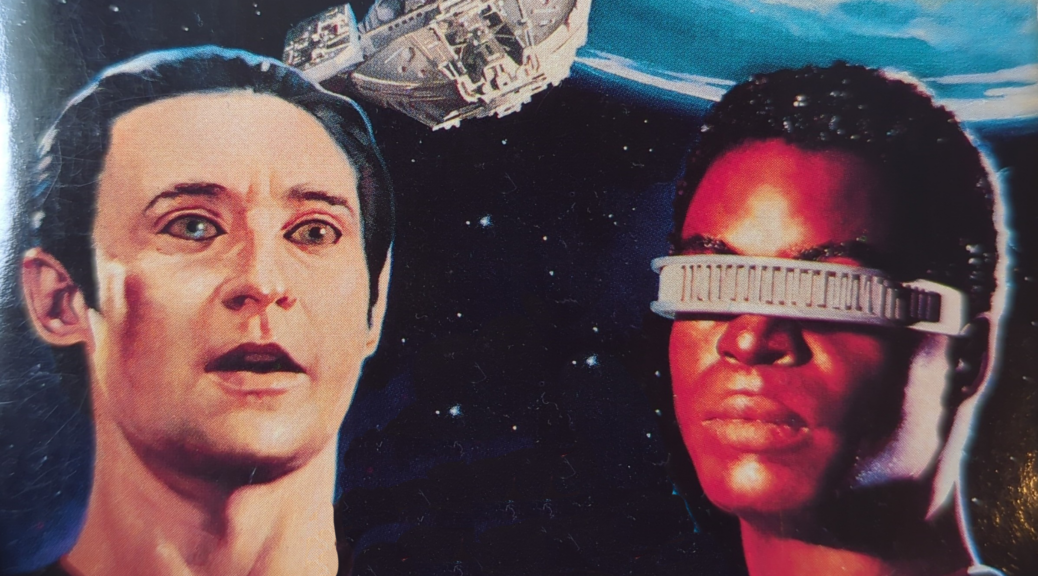
Things I might borrow from this book: Inter-dimensional ghost ships, Wesley’s science project that amps up phasers, Picard’s cool escape maneuver using a gas giant, and the science dingy Riker pilots to go after Data.
I’d say this book is on par with an average Season 1 Next Gen episode— it’s worth watching if it happens to be on.