
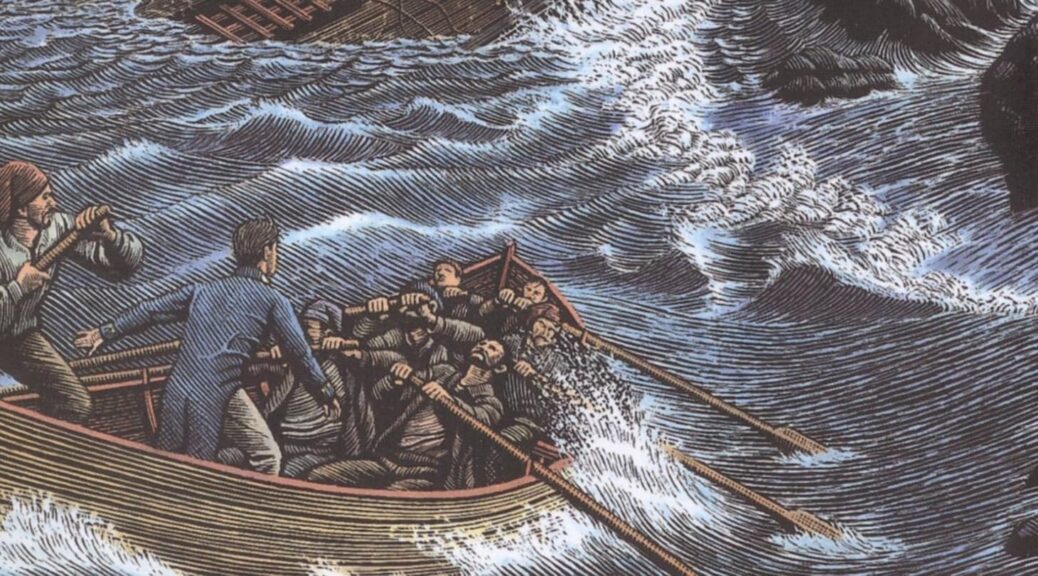
I know it’s not a Trek book exactly, but hear me out, it’s related.
So, some years and years ago, I had come across a behind the scenes interview with the actors talking about their experience starting out on the set of Star Trek: The Next Generation. I remember Patrick Stewart saying that when he asked for direction on the character of Jean Luc Picard, Gene tossed him a copy of Horatio Hornblower and said that’s Picard, do that.
All I could infer was that is was some age-of-sail historical fiction (alluded to in the show occasionally in holodeck programs). I had spied the books on the library shelf once or twice, but the timing never lined up for me— I always had too many things I happened to be reading anyway.
But this past winter, it was time. I happened on the first two Horatio Hornblower books at a library sale for just a buck and I threw them on top of my tipsy tower of selections, dropping a twenty like the big spender I am. I can’t help it. Books look at me like lost kittens and I can’t just let them there at the book pound, forlorn and unappreciated. So these came home with me. Even if I only have the time to hug them and sniff their sweet VOCs and not actually read them all. It’s my therapy. My book-o-phile peeps all get me.
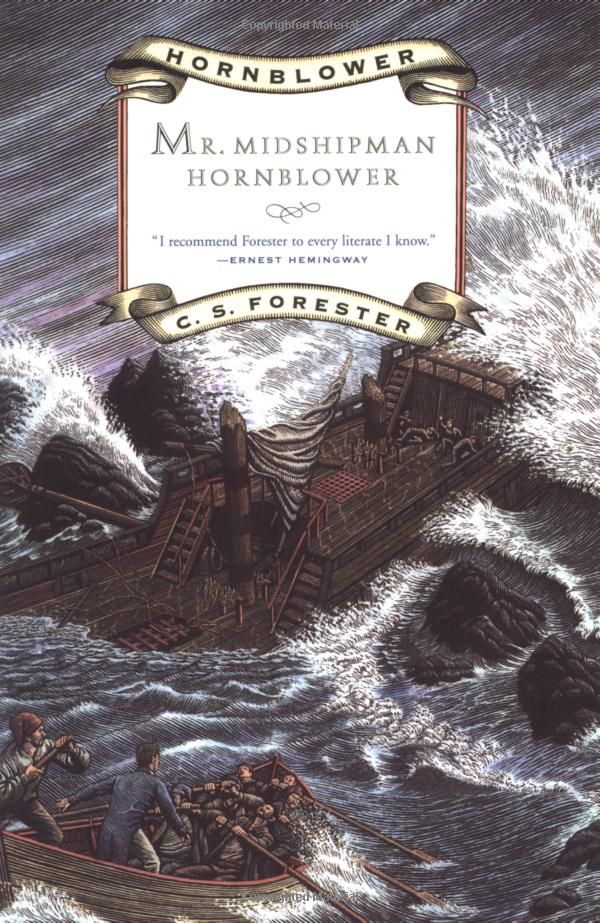
What especially sold me on Hornblower this time though was that, as opposed to the fading hardcover library copies, in the 1998 softcover edition of this book, on the front cover directly under the title it features one reviewer quote that makes it feel like a crime to pass this book up. It reads thusly:
“I recommend Forester to every literate I know.” —Ernest Hemingway
Ernest gosh-darn Hemingway! I’ve never actually read a significant amount of Hemingway, but I understand he comes highly recommended. And if he recommends Forester to every literate (and hey, I can read!) well, by-golly-george, put this in my reusable store bag. Let’s go.
My expectations were high, is all I’m getting at here. What I expected going in was basically Jean Luc Picard on the high seas in a page turner literary masterpiece.
Friends. I was not disappointed.
Mr. Midshipman Hornblower
By C.S. Forester
As you crack open this book, a scrawny adolescent is delivered, wet and bedraggled, to his first ship assignment. When asked his name he gives it as Horatio Hornblower. “What an infernal piece of bad luck for you.” One of his new crew mates dishes out. On further hearing that he’s seventeen, the opinion is that he’s begun his sailing career too late in life to know anything of value and he should have begun at twelve. Picard, I mean Hornblower, responds with a promise to read up on the parts of the ship in his Seaman’s handbook.
We’re only a few pages into this leading chapter when our hero is set about with a serious quandary— while pasty colored, gawky, and inexperienced, he’s very book smart and quickly outpaces men twice his age in his navigational studies. This gets under the skin of one older Midshipman who proceeds to make things miserable enough for Hornblower that the poor boy contemplates how he’d much rather find a way of quitting this life and thus have an end to the never ending torments.
One day at a game of cards our young protagonist seizes an opportunity to accuse his tormentor of offending his honor, and there’s nothing for it. He demands the right to duel to the death in defense of his reputation and good name of Picard, I mean Hornblower.
There’s no chance of him surviving this match. But he’s headstrong and determined and the duel is set.
I won’t tell you how it’s resolved. Suffice it to say this is the first chapter in an eleven book series all titled for Hornblower and following him into his Admiralty, so I don’t think I’m ruining the plot for you by saying he survives, but the manner in which he does so is eminently worth reading.
The following chapter entitled Hornblower and the Cargo of Rice, in which he guides a prize ship with a cargo hold full of valuable rice, is even more thrilling and I am still, weeks later, smiling at the memory of having read it. Each chapter, while tracking chronologically in a timeline of Hornblower’s career, can serve as a standalone read unto itself, clearly serving the love of those of us who find episodic fiction most endearing.
They’re all amazing, detailed, and whip-smart, full of twisting plots, sharp character studies, well informed context of sailing ships and battle tactics on sea and on land, and convincingly set scenes throughout the Mediterranean and Western European coast. Every single chapter deserves an entire review unto itself.
If you need a real Picard series, Hornblower is your man.
