
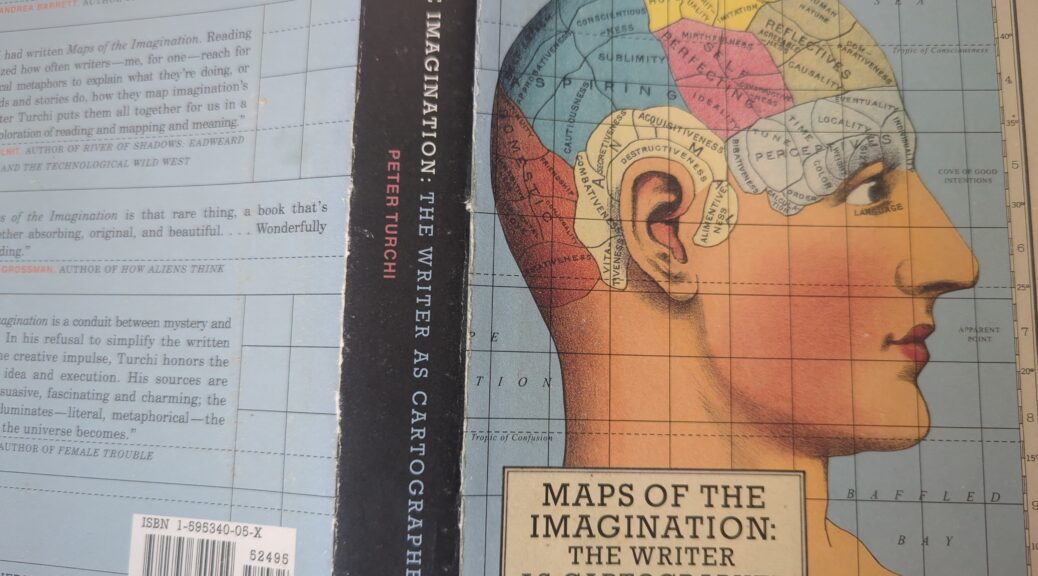
Someday (soon I hope) I will be sharing more of my stellar cartography efforts for all to appreciate and to use in their mission/ campaigns or to be inspired by when writing or talking about Star Trek, but on the way between now and then, I sometimes read material tangential to all of these efforts. Last year was marked in my life by a considerable amount of time spent in waiting rooms. Aside from taking more naps while sitting upright (a learned skill) I tend to read more books in these situations, and one of the books that helped me pass the time last year was Maps of the Imagination: The Writer as Cartographer, by Peter Turchi.
I think for anyone who has been in the writing craft for a while, it’s likely to have encountered the concept of ‘the mind palace’ which is a storytelling memory device of walking through your narrative as if going through a home or a castle and traveling from room to room. Memory seems to map experience with place, and so the writer can take advantage of this. I have heard many orators explain this as their practice of how to deliver a talk with minimal, if any notes, and in pre-literate society without the technology of alphabets, papyrus, or electromagnetically-recorded binary-encoded type, the mind palace or similar imaginary “maps of the mind” must have been an essential tool for educated minds to transmit epic stories, deliver hard-won wisdom, and preserve generational knowledge.
Turchi moves a little further afield and suggests that far beyond writing, almost everything we engage in is a matter of trying to create or use a denotation system in order to make massively overwhelming reality into navigable, comprehensible, and communicable portions which we can take with us via either memory or by any of an innumerable methods of demarcation (maps!), and which we can ultimately share with or pass on to others. What is an alphabet if not a mapping of sounds? Are words and phrases not a legend for meaning? We use all of this to compress the universe into digestible bits and then to expand them again when we look to go back out into the terrain to explore more of the world. Animals often have their own methods of this too. A bee may dance to tell tell other bees where she has found pollen, and they memorize and exchange this compressed information, trading the complexity of the world for a few signals that can lead them to success and security for the hive. Although there is no written or recorded persistence of the insect’s game crossover between “charades” and “telephone”, the little bee has made herself and her sisters a map.
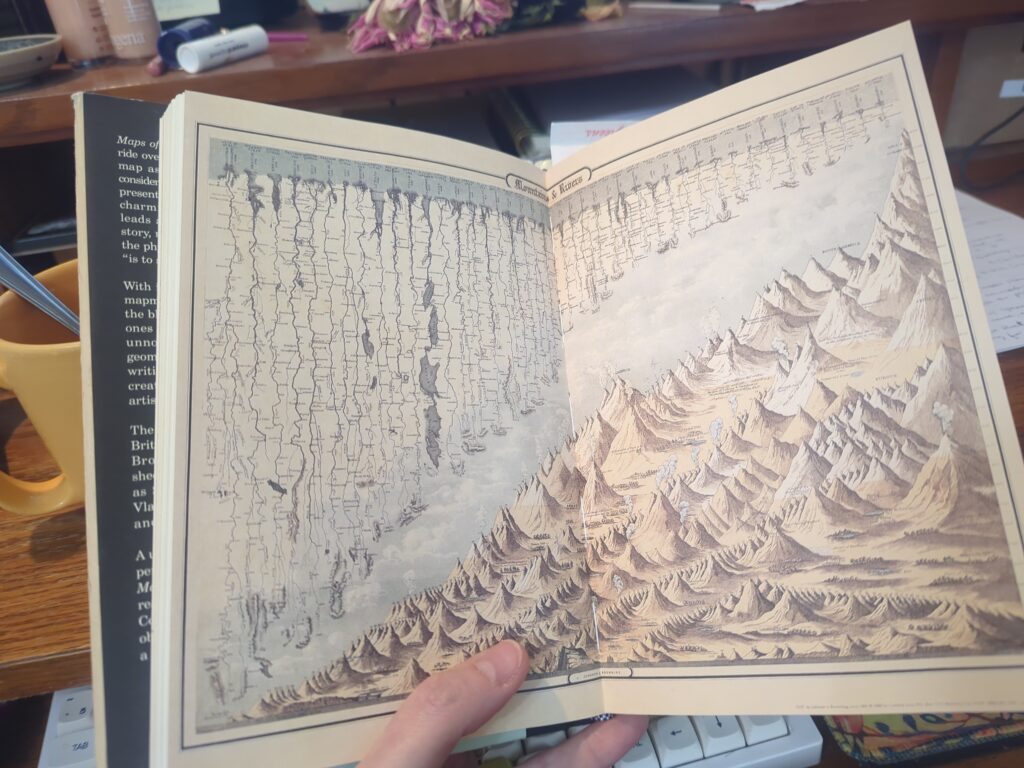
When you read Turchi’s book, you may get the feeling that everything we do and all the media we engage with is maps. We might even argue that reality therefore is a map as well, just the highest and most detailed form (you can see where simulation theorists might be caught up in thoughts of this nature! But Turchi doesn’t spend much time worrying about this). In Turchi’s opening page he proposes that: To ask for a map is to say “Tell me a story.” And the book is filled with a diversity of ideas expanding on what kinds of things are maps and what it means to be a cartographer and how we choose what to focus on in our mapping systems and ultimately, what use the approach of mapping means for us as writers; ultimately what is writing if not an exploration on which we are trying to bring along another person?
So we as writers might say: here is the story, and how it unfolds, and if you follow along on the path I’ve marked out, you will share an experience in the thought palace, and if I’m especially perceptive and well honed as a writer, I will have mapped out something about the shared human experience that will be unpacked in your own journey as you follow the trail I’ve drawn, such that you and I will have seen the same landscape but from our own eyes, in our own unique perspective. And maybe you too will be inspired to make another map for another traveler.
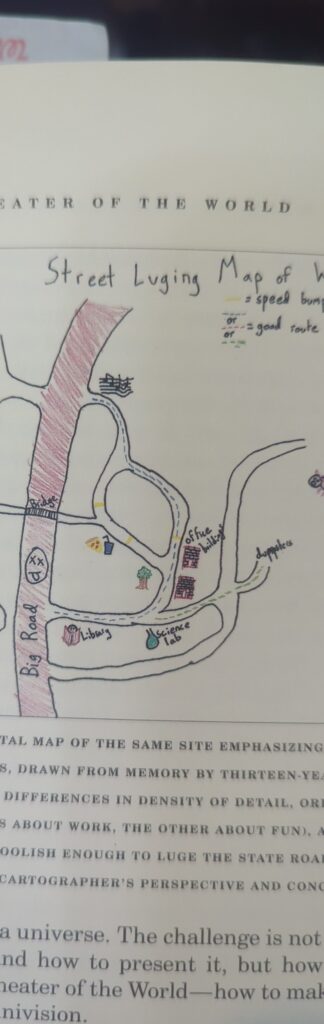
The range of explorations in the book is too wild to summarize, both serious and whimsical, popular and esoteric, and yet all pulled together in a way that feels like an enlightened “aha!” The imagination will not be made up of straight lines, of this it is clear, but the journey along with this author through rabbit trails of history and fiction, of sledding with his son and reading the plot of his father’s land, of tracing cows daily plodding through pasture, of the cartography of common board games and the logic of Sunday morning cartoons, of non-linear stories and of treasure maps, of higher geometries on 2-D planes – it all is a guided map tour charting a course through the ways we navigate our interior and exterior lives using story as our cartographic stars by which we are guided, and along which we may point others. ~