
I had a wonderful experience on vacation this summer, exploring a used bookstore in another state several hours away from home. This place had a whole scifi section and a book case that included several solid shelves full of Star Trek novels.
Years ago, in the halcyon days of the 90s, when we didn’t know we were living the dream, I used to buy TNG paperbacks at the pharmacy around the corner from me at full price with my babysitting money. I considered this a fair trade of goods and services, and I really enjoyed the books.
But as life carried on and I had to handle my limited storage space in apartments and my first time home, I had to let go of those paperbacks. And now I’m making up for it by restocking, and discovering titles that I never saw on the pharmacy’s spinning rack in the 90’s. Who knew the future would return to me such bounty?
So the first I grabbed out of this newly acquired stack happens to be Perchance to Dream, by Howard Weinstein. And I am promising you my unfiltered hot takes. Spoiler alerts abound: I’m not going to any effort to hide the events of the story.
Lets get into it.
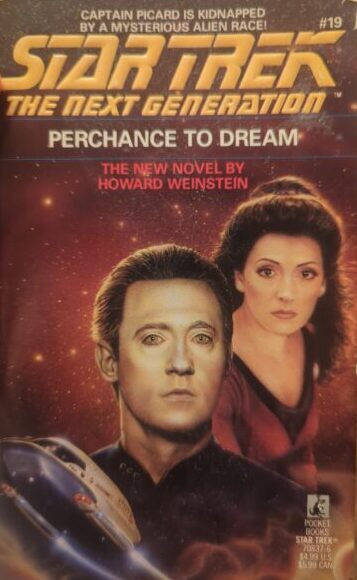
Perchance to Dream (2000)
by Howard Weinstein
I’m not really sure how to begin talking about this novel. I’ve tried to put my finger on just why it’s difficult to select an approach, and I think it’s because this novel isn’t especially remarkable. It’s easy to talk about something very bad or very good, very bold or very uncanny. But with a book like this, I feel that the author has some writing chops, and the story is followable, but nothing is especially unique or clever.
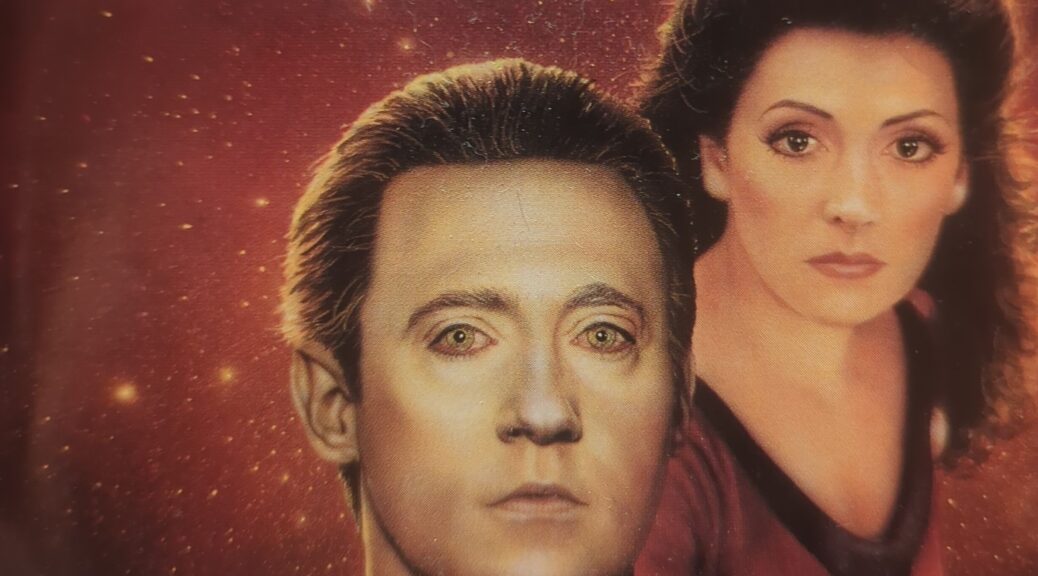
While the book cover advertises Data and Troi and is framed in the beginning with their plight, and in the end with their discovery— the story’s A plot seems to consist mainly of Picard. It’s Picard’s problem that the away team has gone missing before his eyes on the view screen. One moment it was in the grip of an unknown alien vessel with a belligerent captain, the next moment, it is stolen away within a flash of rainbow energy.
The shuttle crew was on a survey mission, studying the geography of the planet. Aboard are some Starfleet hopefuls including Wesley and two other sixteen year old companions. Data and Troi are there to guide them through the easy geology survey as a prelude to their further training. The kids act like kids.
Beverly Crusher is teased in a few scenes at the beginning of the book, but as the plot thickens, she basically disappears to distract herself in the medical lab, worried about her missing son, but being helpless to do anything about it. Of all the deciscions made in the framing of this story, this one probably discouraged me the most. Crusher essentially decides that Troi is with him whereever he has gone missing to, and that as her closest friend she trusts Troi to look after Wesley. This isn’t entirely awful. As a parent I know from experience that sometimes, especially with your proto-adult teenagers, you have to trust other reliable adults to guide them in life. But Dr. Crusher is a smart woman, and as the story continues, there is ample opportunity to graft her into the search for her son. I can’t imagine not lending all the effort in my power to offer— even if the solution didn’t result from any of my own striving. Dr. Crusher doesn’t strike me as an indifferent or emotionally distant character, so this was difficult for me to accept in the story. Whether you like or dislike the mother and son Crusher duo, this is simply too reductive.
While each standing on their own bridge, tensions flaring over the disappearance of the shuttle, Picard and the alien captain are inexplicably swept away by the same rainbow juju as took the shuttle. Then, in a budget version of the TNG TV episode “Darmok”, the story follows both captains on the planet’s surface where they suddenly find themselves, cut off from contact with their respective ships. Picard tries to reach out to the other captain but she is aloof and elusive. When Picard has some success at spearing and cooking up some fish, his counterpart comes out of the shadows long enough to eat with him. Then, in the night, the ground shifts and almost swallows him, but, in a trust building turn of events, the alien captain makes the difference and saves our captain. (That was close. We almost saw the end of Picard right there. Cue final credits roll.)
Meanwhile the shuttle crew discovers their entire shuttle has been transferred to a cavern. Which is really scary because one of the kids hates caves (it’s been established in the earliest scenes). Troi does comforting counselor things. Data is characteristically unperturbed. Wesley doesn’t seem so annoying because the other two kids with him take the stage with an awkward non-romance…Remind me again, why does it matter to the story that Wesley happens to even be in this episode? He just seems like a poorly given stakes item, hanging in the balance. But other than a one off narrative nod, the connection to the fact that Picard lost Wesley’s father Jack under a previous mission, never really adds any pressure to the issue for Picard.
Tangentially, the Enterprise is being diverted to the matter of the shuttle, away from the ship’s mission to save some miners in need of emergency care. But that doesn’t add to the stakes either. No one is poorly affected by the diversion of the Enterprise for days over the curious world with the Rainbow strobe effects. We’re not in any rush. Why the author didn’t use this to up the stakes especially for Picard in his leadership decisions, is beyond me. If we wanted to just do something to get Beverly out of the picture, she could show more torment over her son going missing, but Picard could ask her to trust him and need to rely on her to take another shuttle ahead to the mining colony to begin their emergency treatment. See? This isn’t hard to lend stakes and credibility with everything that is already in the pages of this book.
Somewhere in the middle of the book, we are given some new insight which our intrepid heroes cannot have. The rainbow light shows are the work of sentient beings, and the glowing creatures are curious about these odd things in their creative space which arrived in weird containers in the sky. The story becomes about a planet of powerful earth shapers, and a remnant alien ship desperate to make a home, while our Prime Directive driven crew cannot allow the settlement project to proceed without proper regulatory zoning law having been met to be sure this isn’t already someone else’s planet— and besides, a shuttle is unaccounted for, and that can’t be waved off.
In the end, the light creatures manage to puppet Data and use him to communicate. Which is not a disturbing violation of personhood at all… and everything is hashed out between them and the newcomers, because it turns out they are lonely just shaping the geology of their world with no one to appreciate their effort. Besides, they sleep for a thousand years between every earthwork at which time their leader is whichever ball of light reawakens first and there’s no chance that won’t work… like with that one dissenting ball of light who thought that the current leader was making a serious mistake checking if these weirdos were legit lifeforms.
It’ll be cool.
Now that everyone is settling in nicely on the planet that tried to swallow him in an active rockslide, Picard gathers up the shuttle and the Enterprise zips off to help those miners. The end.
I know I’m being a little hard on this book. I did enjoy reading it. In fact, I think if I had read it when it back when it had been published, I may have been more enamored. Things I liked about it were that both of the aliens introduced in this book were very alien; the ship of refugees had a description that would have stretched old TNG makeup departments and the other aliens were genuinely made up of light and had a unique society. Data and Troi were juxtaposed well with one another as mentor characters to the teens, and if I had been reading this book as a teen I may have felt a connection to these characters (Gina, Ken, and Wesley) as they were strongly featured. Like wise, the plot would not have challenged me, allowing me to keep up with the story. Even the multiple times that Geordi spouts off clichés might have failed to have me grinding my teeth as I did now reading this book in my adulthood.
In the end Picard sums up the question the book’s author wants us to ask: Do sentient beings create only for the sake of creating, or do they create for an audience who gives a purpose to their creative act?
And this is why we are all here for anything Star Trek. To ask the unanswerable questions. Am I writing this review for myself, or for you, “dear reader”? I’m not sure. I certainly get more out of it by imagining a friendly ear in the world, inclined in my direction.
Some how, as the kids say now, this book was mid. I didn’t not like it. I think I just wish I could reach through a space-time anomaly to beta read this manuscript and leave some suggestions for the author, immediately after which, I would witness the cover art time-shift to an honest-to-the-content depiction of Picard and Wesley, and pickup the book from my nightstand to give it another chance.